
GDP Day: Interpreting the Q1 GDP Print Without the Hype
Why the headline number matters less than what’s driving it, and how to read the real signal.
There’s a moment every quarter when the market collectively leans forward.
GDP Day.
The number hits. Headlines explode. Markets react.
And for a brief window, it feels like this one number defines everything.
But if you’ve been watching long enough, you know the truth:
The headline rarely tells the full story.
The Trap: Why GDP Headlines Mislead Investors
When GDP prints, most people see one thing:
“The economy grew X%” or “The economy contracted Y%.”
Simple. Clean. Misleading.
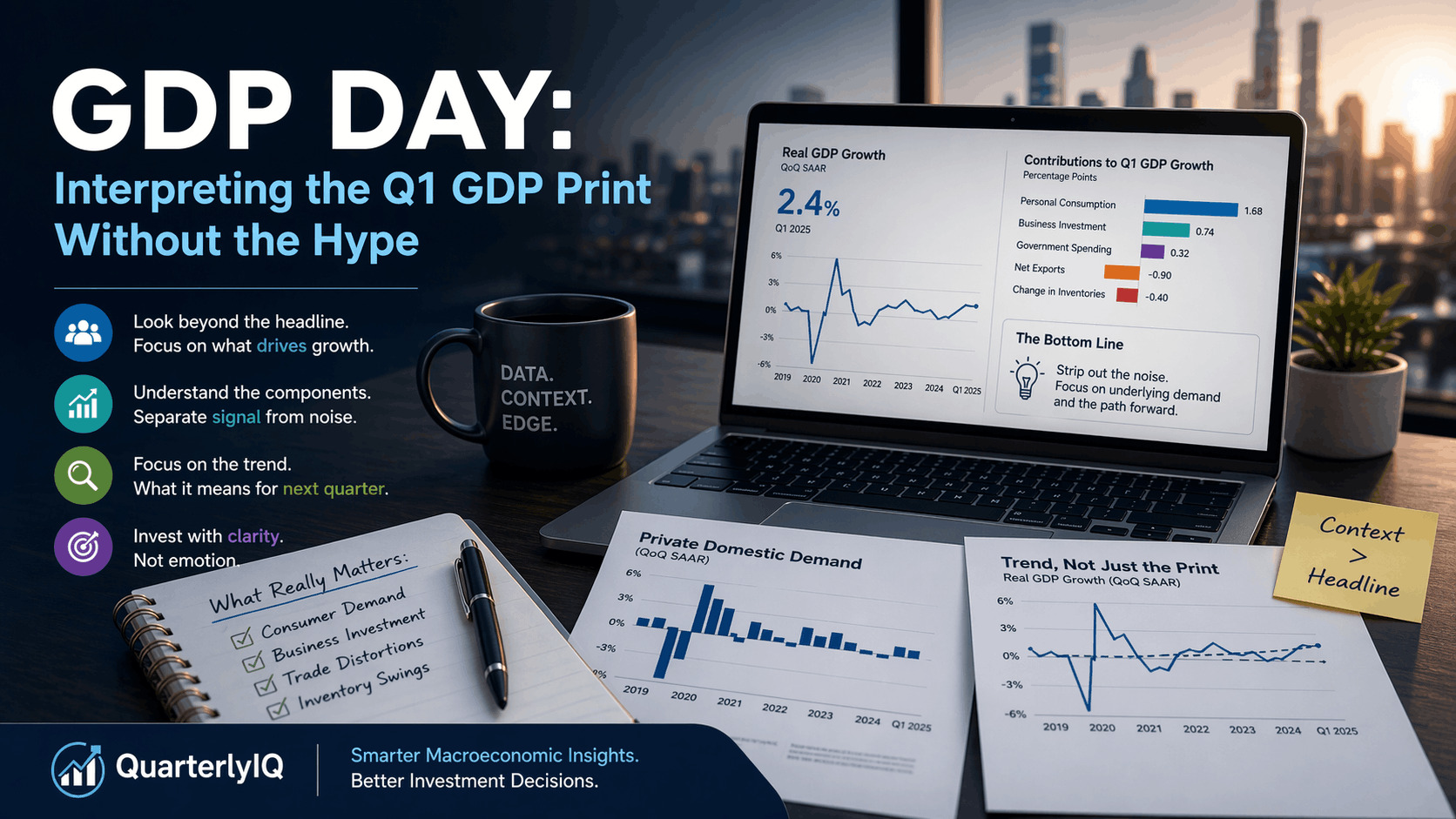
GDP is not a single signal—it’s a blend of moving parts:
- Consumer spending
- Business investment
- Government spending
- Trade (exports – imports)
- Inventory changes
And sometimes… one of those pieces completely distorts the picture.
The Right Lens: Read the Engine, Not the Speedometer
Think of GDP like a car dashboard.
The headline number? That’s your speedometer. Helpful—but not enough to understand what’s really happening.
To understand direction, you need to look under the hood:
1. Consumer Spending (The Engine)
This is the backbone of the economy.
- Still growing? → underlying demand is intact
- Slowing? → early warning signal
If you only track one component, track this.
2. Business Investment (Forward Intent)
Companies don’t invest randomly—they invest when they’re confident.
- Rising investment → optimism about future growth
- Falling investment → caution, tightening conditions
This is where the next quarter starts to show up early.
3. Trade (The Biggest Source of Noise)
Trade can completely distort GDP.
- Imports subtract from GDP
- Exports add to GDP
But here’s the nuance:
A spike in imports doesn’t mean weakness—it often means demand is strong.
This is one of the most misunderstood parts of GDP.
4. Inventories (Temporary Illusions)
Inventory swings can make GDP look stronger—or weaker—than reality.
- Inventory build → boosts GDP today
- Inventory drawdown → drags GDP today
But both are often temporary shifts, not real demand signals.
The Real Signal: What You Should Actually Watch
On GDP Day, instead of asking:
“Was GDP strong or weak?”
Ask this instead:
“Is the economy strengthening—or weakening beneath the surface?”
That’s where the edge is.
A better shortcut:
Focus on private domestic demand (consumption + investment)
This strips out a lot of the noise and shows you what’s actually happening inside the economy.
Why This Matters for Investors
Markets don’t move on GDP. They move on expectations vs reality.
And more importantly:
They move on what GDP implies for the next quarter.
Here’s how to translate the data:
If consumption is strong
→ Earnings resilience likely → Supports equities (especially consumer + services)
If investment is accelerating
→ Future growth improving → Bullish for cyclicals, industrials, tech
If trade distorts the headline
→ Ignore the noise → Look for reversal effects next quarter
If everything is slowing at once
→ That’s when risk actually rises → Defensive positioning starts to matter
Where QuarterlyIQ Fits In
This is exactly where most investors struggle:
Too much data. Too many headlines. Not enough clarity.
QuarterlyIQ is built to answer a simple question:
What does this mean for the next quarter—not just today?
Instead of reacting to the headline, we:
- Break down what’s driving the number
- Compare it to expectations
- Track how competitors and sectors are behaving
- Layer in macro conditions to identify tailwinds or risks
Because investing isn’t about reacting faster.
It’s about understanding deeper.
The Bottom Line
GDP Day isn’t about the number.
It’s about the story beneath the number.
And the investors who win over time are the ones who can see that story clearly—before everyone else does.
Final Thought
Next time GDP prints, don’t ask:
“Is this good or bad?”
Ask:
“What is this really telling me about what comes next?”
That’s where the edge lives.