
The Signal Before the Surge: What Intel’s Earnings Really Revealed
Why the semiconductor rally didn’t start with Intel’s report, and what most investors missed before the move.
Yesterday didn’t start as a headline.
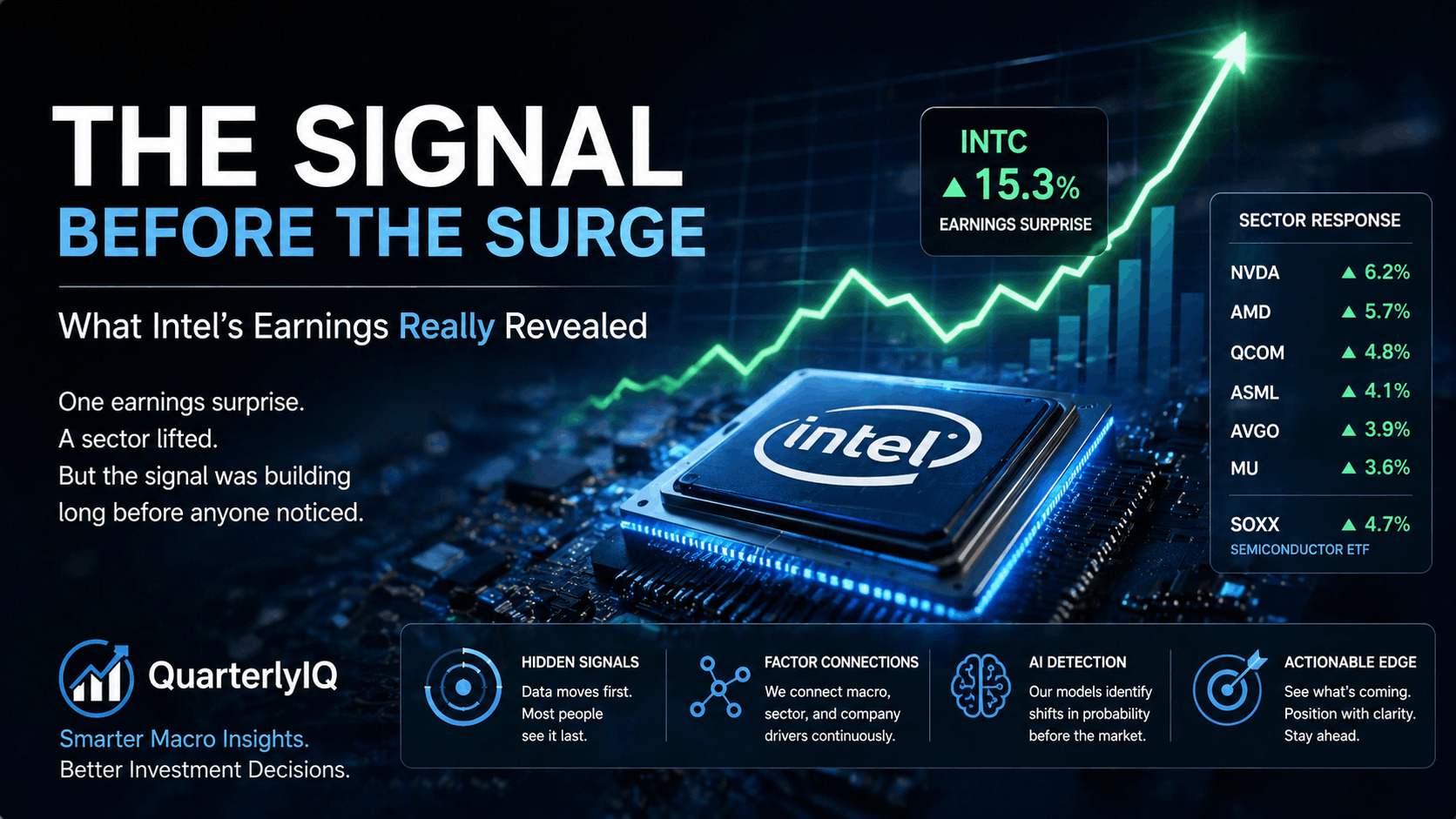
There was no early warning banner across financial media. No consensus call that something big was about to happen. And yet, by the end of the day, the entire semiconductor sector was moving, pulled higher by one company’s earnings surprise.
That company was Intel.
What looked like a single earnings beat quickly became something more: a shift in narrative, a change in expectations, a ripple that spread across peers, suppliers, and the broader market. The move wasn’t isolated. It was systemic.
And like most systemic moves in markets, it didn’t begin yesterday.
The Moment Everyone Saw
When Intel reported stronger-than-expected results, the reaction was immediate.
Investors recalibrated. Growth assumptions changed. The story around AI infrastructure, chip demand, and capital spending suddenly felt different, more real, more urgent.
The result:
- Intel surged
- Semiconductor peers followed
- The entire sector lifted in sympathy
From the outside, it looked like a reaction.
But reactions are just the visible part of a deeper process.
Markets don’t move because of data alone. They move when expectations collide with reality.
What Actually Happened
The earnings release wasn’t just a number.
It was a signal.
A signal that:
- Demand may be stronger than modeled
- Margins may be stabilizing faster than expected
- Capital cycles could be turning
That signal didn’t just belong to Intel. It applied, at least partially, to the entire ecosystem.
Suppliers. Competitors. Customers. Even adjacent industries.
This is how sectors move.
Not because every company reports at once, but because one company reveals something the market wasn’t fully pricing in.
The Problem With Watching Earnings
By the time the earnings hit, the move has already started.
Even if you react quickly, you are:
- Interpreting the signal at the same time as everyone else
- Competing with faster systems
- Buying into momentum rather than anticipating it
The real question isn’t: “What happened after the earnings?”
It’s: “What was already building before it?”
Where the Signal Begins
Every earnings surprise is the result of something that existed earlier:
- Shifts in macro conditions
- Changes in supply chains
- Gradual improvements in leading indicators
- Subtle correlation changes between factors
These signals rarely show up in one place.
They are scattered:
- A macro datapoint here
- A pricing trend there
- A divergence between companies in the same sector
Individually, they don’t look like much.
Together, they form a pattern.
Seeing the Pattern Before the Move
This is the problem we set out to solve.
Not predicting earnings in isolation. Not reacting to headlines faster.
But identifying the conditions that make a sector move likely before the move happens.
That requires a different way of looking at markets.
Instead of focusing on companies alone, you have to understand:
- What drives them
- How those drivers are evolving
- When those drivers start to align
At QuarterlyIQ, that means building a system that continuously ingests macro, market, and company-level data into a unified structure — one where relationships can be measured, not guessed.
From there, the goal is simple in concept, but difficult in execution:
- Map the factors that influence each company
- Measure how those relationships change over time
- Detect when those changes begin to cluster
Because when multiple signals begin pointing in the same direction, the probability of a move increases.
Not certainty.
But probability.
From Company to Sector
The real inflection point isn’t when a company surprises.
It’s when that surprise applies beyond the company.
That’s when:
- Correlations tighten
- Narratives shift
- Capital reallocates
A single earnings report becomes a sector move.
Intel didn’t just move because of its own results.
It moved because its results meant something broader.
The Reveal
If you zoom out, yesterday wasn’t about Intel.
It was about the system underneath the market revealing something that had been building quietly.
A change in direction. A shift in expectations. A signal finally becoming visible.
The challenge — and the opportunity — is learning to see that signal earlier.
Not perfectly. Not with certainty.
But with enough clarity to recognize when something is changing before everyone agrees that it has.
What Comes Next
There will be another moment like this.
Another company. Another surprise. Another sector that moves all at once.
And again, it won’t start on the day of the earnings.
It will start earlier — in the data, in the relationships, in the subtle signals that most investors don’t see because they aren’t looking for them.
The market will call it a surprise.
But it rarely is.
It’s just the moment when everything that was building finally becomes obvious.