

How to Use QuarterlyIQ to Build a Smarter Investment Planning Routine
A simple, repeatable process for using macro signals, company drivers, and quarterly thinking to make calmer investment decisions.
Most investors do not have an information problem.
They have a process problem.
There is no shortage of news, data, charts, or opinions. The real challenge is knowing what to look at, when to look at it, and what actually matters before the next quarter shows up. Without a routine, every headline feels important, every move feels urgent, and every earnings report feels like a surprise.
A smarter investment routine fixes that. It does not ask you to spend all day watching the market. It asks you to build a repeatable way to understand what is changing, what matters most, and what deserves your attention now.
That is where QuarterlyIQ should be useful: helping investors spend less time drowning in updates and more time seeing the setup clearly.
The goal is not to do more
A better routine does not mean more activity.
It means better focus.
The market has a way of making busy people feel informed. But scrolling faster is not the same thing as thinking better. A strong routine should help you understand the macro backdrop, spot what is changing around the stocks you follow, prepare for earnings before emotions take over, and filter out the noise that does not deserve a seat at the table.
That is enough. In fact, that is more than enough for most investors.
Start with the bigger environment
Before you look at a single stock, zoom out.
Every company reports inside a larger environment. If inflation is sticky, costs can stay high. If growth is slowing, demand can soften. If rates are still pressuring borrowing, that can hit everything from housing to valuations. If the consumer is weakening, a lot of earnings stories start to wobble at the same time.
So before you dive into your watchlist, ask a few simple questions.
Is inflation easing or staying stubborn?
Is growth improving or losing momentum?
Are rates helping or hurting?
Is the consumer still holding up?
Is the macro backdrop becoming a tailwind or a headwind?
This is the first job of a good routine. It helps you understand whether the sea is calm or whether a storm may be forming before earnings arrive.
Then focus on what is changing
Once you understand the backdrop, move to the stocks you actually care about.
The key question is not just, “Do I still like this company?”
It is, “What has changed that could matter before the next report?”
That change can come from a lot of places. A competitor may report weaker demand. A supplier may talk about cost pressure. A sector may start rolling over. A rate move may suddenly matter more for a leveraged business. A stock may rally hard before earnings and quietly price in a lot of optimism.
This is where many investors get lost. They treat all updates as equally important.
They are not.
The goal is to find the few changes that actually affect the setup.
Use QuarterlyIQ to narrow the setup
A smarter routine should help you identify whether a stock looks set up for a meet, a beat, or a disappointment.
That does not mean trying to predict every quarter down to the penny. It means narrowing in on the handful of drivers that matter most.
Usually, the highest-value work is simple. What are the key company drivers? What are peers saying? Does the macro backdrop support or pressure the story? And do expectations already look too high or too low?
That is where QuarterlyIQ should earn its keep: helping investors connect the macro backdrop, sector tone, and company-specific setup before the market gets loud about it.
Because the best pre-earnings work is rarely about knowing everything. It is about knowing what matters.
A routine that is simple enough to keep
The best routine is the one you will actually follow.
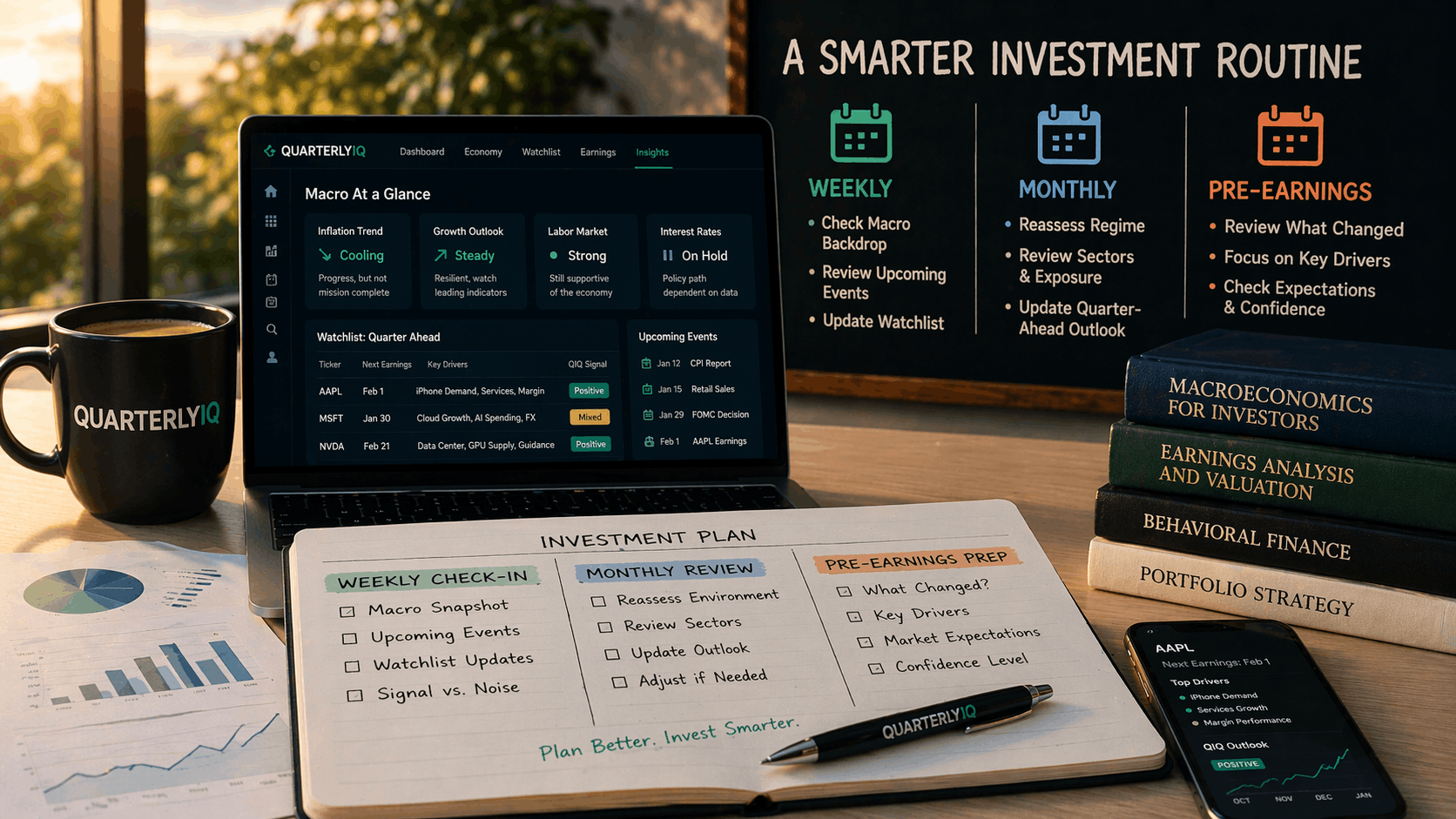
Weekly
Once a week, do a short check-in.
Look at the macro backdrop. Check the biggest upcoming releases or earnings events. See what competitors are signaling. Review whether the setup for your watchlist is improving, weakening, or staying mixed.
This is not about predicting the future. It is about staying oriented.
Monthly
Once a month, zoom out a little further.
Ask whether the broader environment has changed. See whether sector trends are getting better or fading. Think about whether your portfolio still fits the current backdrop. Decide what you think is most likely over the next quarter.
This helps prevent emotional drift, which is just a polite way of saying, “I got pulled around by noise.”
Before earnings
This is where the routine becomes especially valuable.
Before a company reports, ask:
What is the market already pricing in?
What are competitors telling us?
Is the macro backdrop supportive or getting worse?
Does this look like a likely meet, beat, or miss setup?
And one more question matters a lot:
If the company beats, is that enough?
That is the part many investors miss. Finding a likely beat is only half the job. You also need to decide whether the facts still support upside after the report.
What a routine helps you avoid
Without a process, every update feels urgent.
That leads investors to overreact to headlines, ignore the bigger environment, treat every signal as equally important, and confuse activity with conviction.
A good routine slows that down.
It helps you put each new piece of information in the right place. It reminds you that a stock does not live in isolation, and that one exciting headline is not always the same thing as a better setup.
That is how better judgment starts to build.
The takeaway
A smarter investment routine is built on a few simple habits.
Start with the macro backdrop.
Watch what competitors are revealing.
Focus on the few company drivers that matter most.
Look at whether expectations seem too high or too low.
Then decide whether the setup supports confidence, caution, or patience before earnings.
That is how investors stop reacting to noise and start preparing with more clarity.
Because better decisions usually do not come from moving faster.
They come from seeing the setup more clearly before the market fully prices it in.
Want help building that routine? Follow QuarterlyIQ for plain-English analysis on the economy, sectors, and stocks, and get notified when new breakdowns go live on Telegram: t.me/quarterlyiq